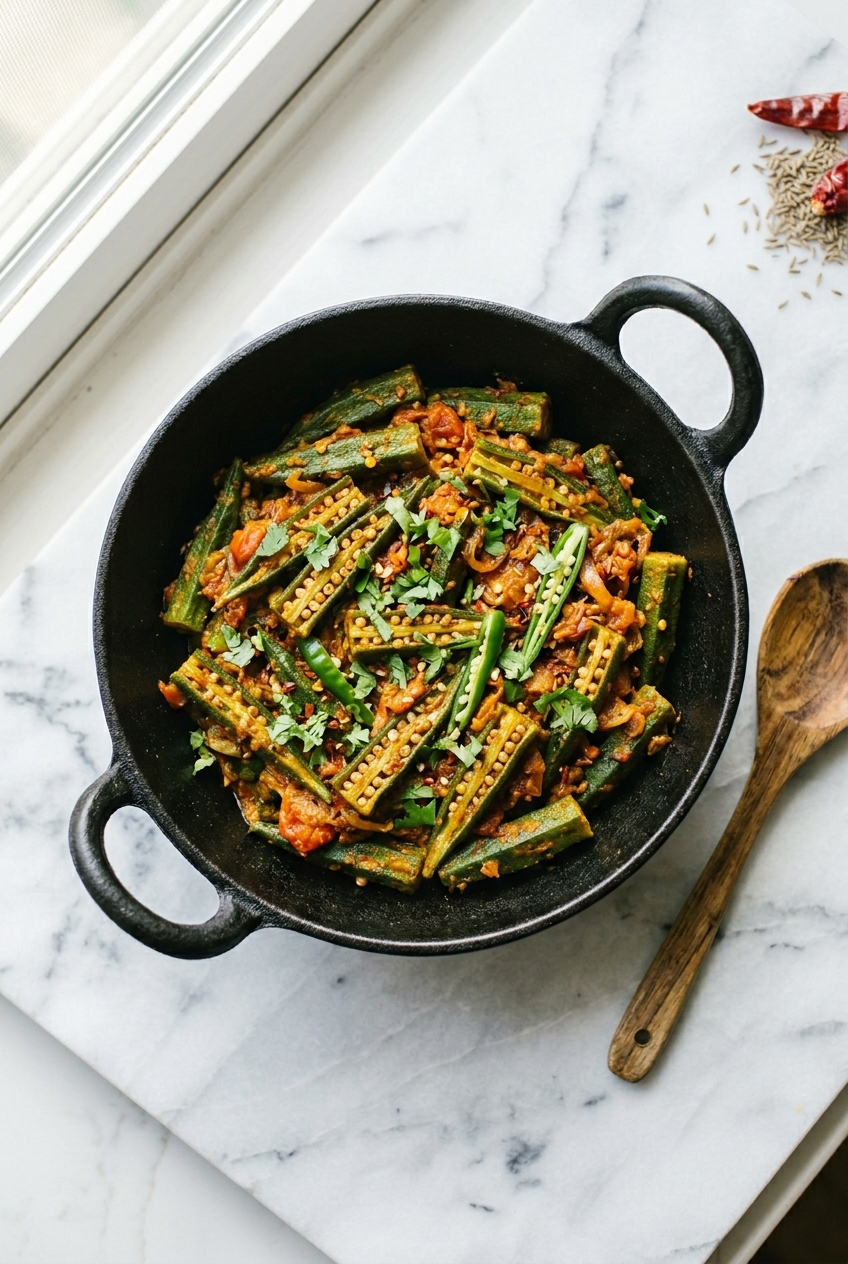
Every time I make bhindi at a potluck, someone corners me and asks: “Why isn’t it slimy?” The answer is two things: completely dry okra before it hits the pan, and a technique my mom used every single week growing up in Gujarat.
Bhindi masala is one of those recipes that sounds ordinary until you eat it made the right way. This is the dry version, not the gravy kind you get at restaurants. The bhindi gets lightly roasted until the edges are just starting to crisp, then folded into a fragrant masala with hing, amchur, and a quick onion-tomato base. It is on the table in 25 minutes, and it disappears just as fast.
If you have always been nervous about cooking bhindi at home, this is the recipe that will change that. Let’s make it together.
What is Bhindi Masala?
Bhindi is the Hindi and Gujarati word for okra, and masala refers to the spiced base it is cooked in. At its core, bhindi masala is sautéed okra tossed in an onion-tomato-spice mixture. Simple, but the execution matters a lot.
Most of the popular recipes you will find online are North Indian style: heavy on onion and tomato, sometimes with a bit of gravy, often served with naan or paratha. The Gujarati version I grew up with is drier, lighter on oil, and relies on hing (asafoetida) and amchur (dry mango powder) for its distinct flavor. We call it bhindi nu shaak at home, and it was a fixture at every Tuesday dinner alongside karela nu shaak and dal.
This recipe sits somewhere between the two traditions. It has the Gujarati soul (hing, amchur, minimal oil) with the aromatics of a North Indian masala (ginger, garlic, cumin). The best of both.
Why Bhindi Belongs in Your Kitchen
Bhindi does not get enough credit as a nourishing vegetable. Here is what is actually in it:
- High in dietary fiber (3.2g per 100g), which supports digestion and keeps you full longer
- Rich in Vitamin K and folate, important for bone health and especially during pregnancy
- Good source of Vitamin C (18% DV per 100g), which supports immunity
- Low glycemic index, so it does not spike blood sugar, making it a good choice for diabetics
- Iron-containing, relevant for vegetarians working on iron intake (pair it with a Vitamin C source for absorption)
- Only ~33 calories per 100g raw, extremely low calorie density
For a full list of iron-rich vegetarian dishes, check out my post on iron-rich vegetarian recipes.
Ingredients
For the Bhindi
- 400g (about 3 cups) fresh bhindi (okra), washed and completely dried
- 1 tbsp oil (for sautéing the bhindi)
For the Masala
- 1 tbsp oil
- 1/2 tsp cumin seeds
- A generous pinch of hing (asafoetida)
- 1 medium onion, finely chopped
- 1 tsp ginger, grated
- 2 cloves garlic, minced
- 2 medium tomatoes, finely chopped
- 1/2 tsp turmeric powder
- 1 tsp red chili powder (adjust to taste)
- 1.5 tsp coriander powder
- 1/2 tsp garam masala
- 1/2 tsp amchur (dry mango powder), or 1 tsp lemon juice at the end
- Salt to taste
Garnish
- Fresh coriander (cilantro), chopped
Jain / No Onion-Garlic version: Skip the onion and garlic entirely. Double the hing to 1/4 tsp and add a pinch of sugar to balance. Everything else stays the same. This version is perfect for festivals like Paryushan or Navratri.

How to Make Bhindi Masala
Step 1: Prep the Bhindi (Do Not Skip This)
Rinse the bhindi under cold water, then spread it out on a clean kitchen towel. Pat every piece dry, then let it air dry for 10 to 15 minutes. Any moisture left on the surface is what causes sliminess, so this step is non-negotiable.
Once dry, trim both ends and cut into 1-inch pieces. Do not wash after cutting.
Step 2: Sauté the Bhindi Separately
Heat 1 tbsp oil in a wide, heavy pan or kadai on medium-high heat. Add the bhindi pieces and spread them in a single layer. Cook uncovered, stirring only 2 to 3 times total, for about 8 to 10 minutes until the edges start to look slightly dry and you see a little color.
Do not cover the pan at any point during this step. Steam is the enemy here. It makes the bhindi soft and slimy. Remove the sautéed bhindi to a plate and set aside.
From my kitchen: The first time I tried this, I stirred constantly out of habit. Completely slimy result. Once I left it alone and let the heat do the work, it came out perfectly. Three stirs maximum.
Step 3: Build the Masala Base
In the same pan, heat the remaining 1 tbsp oil over medium heat. Add cumin seeds and let them sizzle for 30 seconds. Add the hing.
Add the chopped onion and cook for 5 to 6 minutes, stirring occasionally, until soft and lightly golden. Add ginger and garlic and cook for another minute until fragrant.
Add the tomatoes along with a pinch of salt. Cook for 4 to 5 minutes, pressing the tomatoes occasionally, until they break down and the oil starts to separate from the edges of the masala.
Step 4: Add the Spices
Add turmeric, red chili powder, coriander powder, and garam masala. Stir well and cook the spiced masala for 1 to 2 minutes until it smells cooked through and the oil is clearly visible around the edges.
Step 5: Combine and Finish
Add the sautéed bhindi back into the pan. Toss gently to coat every piece in the masala. Cook together for 2 to 3 minutes on medium heat. Add the amchur and taste for salt and spice.
Garnish with fresh coriander and serve immediately.
Tips for Crispy, Never-Slimy Bhindi
- Dry completely before cutting. This is the single most important step. Even a small amount of surface moisture will cause stickiness once the bhindi hits the pan.
- High heat for the initial sauté. Low heat steams the bhindi instead of roasting it. You want the edges to dry out, not sweat.
- Cook uncovered throughout. No exceptions. Steam makes bhindi slimy.
- Stir as little as possible. Two or three turns total for the bhindi-only sauté phase.
- Add acid at the end. Amchur or lemon juice breaks down the mucilage that causes sliminess. It also brightens the whole dish.
- Don’t overcrowd the pan. If your pan is small, sauté the bhindi in two batches. Overcrowding = steaming.


Bhindi Masala (Crispy Dry Okra Masala)
Ingredients
Equipment
Method
- Rinse bhindi under cold water, pat completely dry with a kitchen towel, and let air dry 10-15 minutes.
- Trim both ends and cut into 1-inch pieces. Do not wash after cutting.
- Heat 1 tbsp oil in a wide kadai over medium-high heat.
- Add bhindi in a single layer. Cook uncovered, stirring only 2-3 times, for 8-10 minutes until edges look dry and slightly golden.
- Remove to a plate and set aside.
- In the same pan, heat remaining 1 tbsp oil over medium heat. Add cumin seeds and let sizzle 30 seconds. Add hing.
- Add onion and cook 5-6 minutes until soft and lightly golden.
- Add ginger and garlic, cook 1 minute until fragrant.
- Add tomatoes and a pinch of salt. Cook 4-5 minutes, pressing tomatoes occasionally, until broken down and oil separates.
- Add turmeric, red chili powder, coriander powder, and garam masala. Cook 1-2 minutes until spices are cooked through and oil is visible at edges.
- Add sautéed bhindi back into the pan. Toss gently to coat.
- Cook together 2-3 minutes on medium heat. Add amchur and taste for salt.
- Garnish with fresh coriander and serve immediately.
Notes
Serving Suggestions
Bhindi masala is a dry sabzi, so it pairs well with:
- Roti, phulka, or paratha — the classic choice
- Instant pot jeera rice and palak dal — my favorite combination for a complete weeknight meal
- Gujarati dal and rotli — for a full Gujarati thali at home
- Gujarati kadhi and rice — the kadhi cuts through the spice beautifully
- Masoor dal soup on the side for a lighter, protein-rich dinner
For a bigger spread, pair this with cabbage peas sabzi or carrot peas sabzi as a second dry sabzi. Two sabzis, one dal, and rotis is a proper home-cooked thali.
Storage and Make-Ahead
Bhindi masala tastes best fresh, right off the pan. That said, leftovers keep well in an airtight container in the refrigerator for up to 2 days.
To reheat, use a dry pan on medium heat for 2 to 3 minutes instead of the microwave. This brings back some of the texture. The microwave makes it soft.
Bhindi masala does not freeze well. The texture turns mushy after thawing.
Tiffin tip: Pack it separately from rice or roti so it stays as dry as possible. The moment it sits with moisture it starts to soften.
FAQs
How do I make bhindi masala without sliminess?
Two things matter most: dry the bhindi completely before you cut it (any surface moisture causes stickiness), and cook it uncovered on medium-high heat without stirring too often. Adding amchur or lemon juice at the end also helps, since the acid breaks down the mucilage that causes the sliminess.
Can I make bhindi masala without onion and garlic (Jain)?
Yes. Skip the onion and garlic and increase the hing to about 1/4 tsp. Add a small pinch of sugar to balance the flavor since onion adds natural sweetness. The rest of the recipe stays the same. This version is perfect for festivals like Navratri or Paryushan.
What is the difference between bhindi masala and bhindi nu shaak?
Bhindi masala typically refers to the North Indian preparation with a more prominent onion-tomato base, sometimes served semi-gravy style. Bhindi nu shaak is the Gujarati name for a drier, lighter version that uses hing and amchur as the dominant flavor notes. This recipe is inspired by the Gujarati style but uses some North Indian aromatics too.
Can I use frozen okra?
Fresh bhindi works significantly better for this recipe. Frozen okra has already released moisture during freezing and thawing, which makes it harder to get that dry, slightly-crisp texture. If you only have frozen okra, thaw it completely, spread on a baking tray, and bake at 200C for 10 minutes to dry it out before proceeding.
Is bhindi masala vegan and gluten-free?
Yes to both. This recipe uses only vegetables, oil, and spices — no dairy, no gluten. It works for vegan, vegetarian, and gluten-free diets.
How do I store leftover bhindi masala?
Store in an airtight container in the refrigerator for up to 2 days. Reheat in a dry pan on medium heat for best texture. The microwave softens the bhindi considerably.
Ready to Make It?
Bhindi masala is the kind of recipe I want everyone to have in their weeknight rotation. It is fast, nourishing, and genuinely satisfying, the sort of dish that makes you realize home-cooked Indian food does not need to be complicated.
If you grew up avoiding bhindi because of the texture, I hope this recipe changes that for you the way it did for me. And if you make it, I would love to know: do you prefer your bhindi dry and crispy, or do you like a little gravy?
Made this? Share a photo and tag @petitepaprika on Instagram — I love seeing your kitchen creations!
