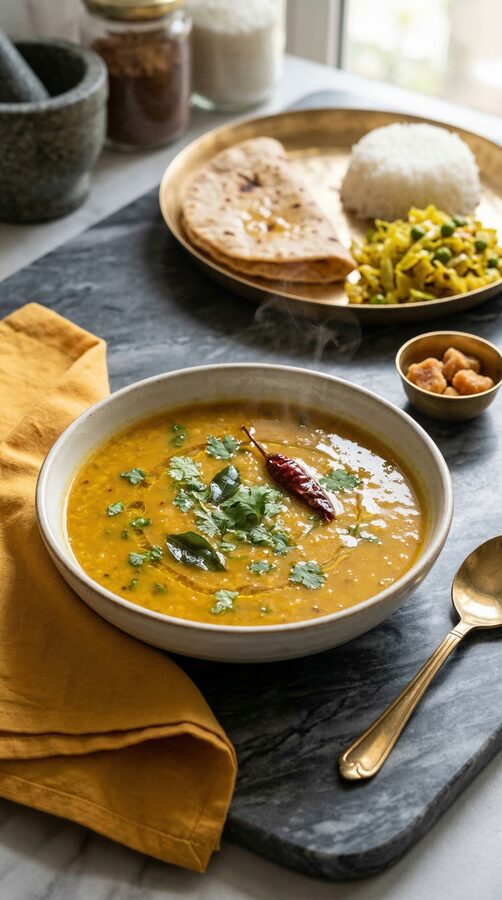
If there is one dish that has been on our dinner table more than any other, it is this dal. Growing up in a Gujarati household, dal-bhaat-rotli (dal, rice, and roti) was not just a meal. It was the rhythm of the week. My mom made it so often that I took it for granted, the way you do with things that are always there.
It was only when I started cooking for my own family that I understood how much skill hides inside this “simple” recipe. Gujarati Dal is not like any other dal. It is sweet from jaggery, sour from lemon or tomato, and gently spiced with a crackling tadka that fills the entire kitchen. Getting that balance right, where no single flavour overpowers the others, took me a few tries. My first batch was too sour. The second was too sweet. By the third, I finally understood what my mom meant when she said “taste it, then fix it.”
This version comes together in about 20 minutes using a pressure cooker. It is Jain-friendly as written: no onion, no garlic, no root vegetables. That is not a modification. This is how Gujarati dal has always been made in most households I grew up around.
🍲 What Makes Gujarati Dal Different?
Most Indian dals are either savoury or mildly spiced. Gujarati dal stands apart because it balances three flavours at once: sweet, sour, and spicy. That combination is the signature of Gujarati cooking and shows up in everything from kadhi to undhiyu.
The sweetness comes from gol (jaggery), which adds a warm, caramel-like depth that sugar cannot match. The sourness comes from fresh lemon juice, tomato, or sometimes kokum (a dried fruit from the Konkan coast). The heat is gentle: just green chillies and a pinch of red chilli powder, enough to warm the throat without burning.
This balance is not accidental. In Ayurvedic tradition, a complete meal should include all six tastes (shadrasa), and Gujarati cooks have been building that into everyday dal for generations. You are eating centuries of kitchen wisdom in a 20-minute pot.
The other thing that makes this dal distinctive is the texture. It is meant to be thin and soupy, almost like a broth, not thick like a Punjabi dal makhani. You pour it over rice or sip it alongside rotli. Pair it with our Lemon Foxtail Millet Rice for a complete Jain-friendly meal. If your Gujarati dal is thick, it needs more water. That is not a flaw in the recipe; it is a feature.
Why Toor Dal Belongs in Your Weekly Rotation
- ✔ High in plant protein — about 22g per 100g of dry dal, essential for vegetarian families
- ✔ Rich in folate and iron — supports energy and is especially valuable during pregnancy
- ✔ Good source of dietary fibre — helps with digestion and keeps you full
- ✔ Budget-friendly — one cup of dry dal feeds 4 people comfortably
- ✔ Pairs with everything — rice, roti, millet bhakri, or just a bowl on its own
💡 Dal Tip: Always wash toor dal 3 to 4 times until the water runs clear. This removes the oily coating (some brands come pre-oiled to prevent sticking) and any dust. Skipping this step can make your dal taste slightly off and foam excessively in the pressure cooker.


How to Make Gujarati Dal

Gujarati Dal (20-Minute, Jain-Friendly)
Ingredients
Method
- Wash the toor dal in cold water 3 to 4 times until the water runs mostly clear.
- Add the washed dal, 3 cups of water, turmeric, and salt to a pressure cooker.
- Close the lid and cook on medium-high heat for 3 whistles (about 8 to 10 minutes). If using an Instant Pot, pressure cook on high for 6 minutes with natural release.
- Once the pressure releases naturally, open the lid. The dal should be soft and mushy. Whisk it with a spoon or use a hand blender for 5 seconds to get a smooth, soupy consistency.
- Place the cooker back on medium heat. Add the chopped tomato and green chillies. Stir and cook for 2 to 3 minutes until the tomato softens.
- Add the jaggery and stir until it dissolves, about 30 seconds.
- Add the lemon juice and red chilli powder (if using). Stir well.
- Add 1/2 to 1 cup of hot water to thin the dal to a soupy, pourable consistency. Gujarati dal should be thin, not thick. Let it simmer for 2 minutes.
- Taste and adjust: more jaggery if too sour, more lemon if too sweet, more salt if it tastes flat. This is the most important step. The balance should feel like all three flavours are present but none of them shouts.
- Heat ghee in a small tadka pan or ladle over medium heat.
- Add mustard seeds and wait for them to pop, about 20 seconds.
- Add cumin seeds and let them sizzle for 10 seconds until fragrant.
- Add the broken dried red chillies, curry leaves, asafoetida, and a pinch of turmeric. Let everything sizzle for 5 seconds. The curry leaves should crackle and the kitchen should smell incredible.
- Pour the entire tadka over the simmering dal. It will splutter. Cover immediately with a lid for 10 seconds to trap the aroma.
- Garnish with fresh coriander and a small squeeze of lemon.
- Serve hot over steamed rice, alongside rotli, or with a millet bhakri.
Notes
FAQs
Q1. Can I use a different dal instead of toor?
Gujarati dal is traditionally made with toor dal (split pigeon peas). You can use moong dal (split yellow lentils) for a lighter version that cooks even faster, but the flavour and body will be different. Masoor dal (red lentils) works in a pinch but breaks down very quickly and will not have the same texture. I would not recommend chana dal here as it stays too firm for this soupy consistency.
Q2. Why is my Gujarati dal not sweet and sour enough?
The most common reason is under-seasoning. Gujarati dal needs a confident hand with jaggery and lemon. Start with the amounts in the recipe, taste, and then add more of whichever flavour feels missing. The sweetness should be noticeable, not hidden. If it tastes like plain dal with a hint of something, you need more of both.
Q3. Is this recipe Jain-friendly?
Yes. The base recipe uses no onion, no garlic, and no root vegetables. This is how Gujarati dal has been made in Jain households for generations. The only thing to check is your asafoetida (hing): some brands use garlic extract as a base. Look for brands labelled “Jain hing” or compounded with rice flour.
Q4. Can I make this vegan?
Yes. Swap the ghee for oil in the tadka. Everything else is already plant-based. Peanut oil or sesame oil both work well and are traditional in Gujarati cooking.
Q5. My dal foams and overflows in the pressure cooker. How do I prevent this?
Washing the dal thoroughly (3 to 4 times) removes the starchy coating that causes foaming. Also, never fill your pressure cooker more than halfway when cooking dal. Adding 1/2 tsp of oil to the cooking water also helps reduce foam.
Q6. How do I store and reheat this dal?
Store in an airtight container in the refrigerator for up to 3 days. The dal thickens as it cools, which is normal. Add a splash of water when reheating on the stove or in the microwave. Give it a good stir and re-taste. You may want a small squeeze of fresh lemon after reheating to brighten it back up.
This Gujarati Dal is the kind of recipe that does not need to impress anyone because it already belongs. It is the first thing I make when someone in the family is unwell, the thing I crave when I have been away from home, and the recipe I will eventually teach my daughter when she is old enough to stand at the stove.
Twenty minutes, one pot, and a handful of pantry staples. That is all it takes. Serve it with rice, rotli, or a Thandai Foxtail Millet Kheer on the side for a full thali. If you have never tried dal with jaggery and lemon together, you are in for a small revelation.
If you make this, tell me: are you team “extra sweet” or team “extra sour”? I would love to hear how your family makes it. Drop a comment below and tag me @petitepaprika 🍲
6 thoughts on “Gujarati Dal Recipe | 20-Minute Jain-Friendly Comfort Food”