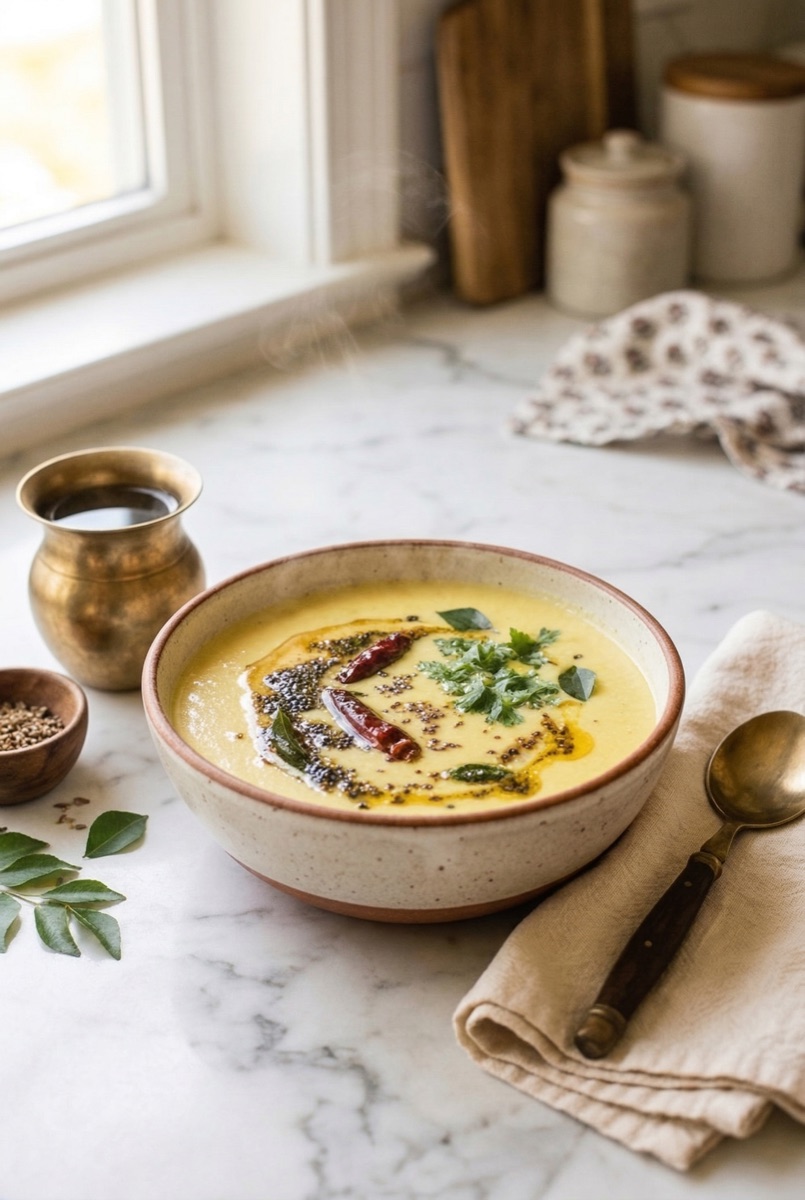
Every monsoon evening of my childhood smelled like this. My nani would set a pot of Gujarati kadhi on the lowest flame possible, stirring it in slow, patient circles while the rain drummed on the window. By the time it was ready, the whole kitchen had that warm, tangy, faintly sweet smell that I still associate with being home.
If you grew up in a Gujarati household, you know exactly what I mean. And if you didn’t, this recipe is your introduction to one of the most comforting things in Indian cooking.
What is Gujarati Kadhi?
Gujarati kadhi is a thin, silky yogurt-based curry tempered with mustard seeds, curry leaves, and a whole dried red chili. It is sweet, tangy, and just barely thickened with besan (chickpea flour). Unlike Punjabi kadhi, which is thick and loaded with pakodas, Gujarati kadhi is light enough to drink from a cup. It is traditionally poured over steamed rice or served alongside Gujarati khichdi for a complete, soul-warming meal.
The sweetness comes from jaggery or sugar, and this is where every family has an opinion. More on that below.
Why You’ll Love This Recipe
- Ready in 20 minutes, start to finish
- Naturally gluten-free
- Easy to make vegan (swap ghee for oil, yogurt for plant-based)
- Just 8 pantry ingredients
- Pairs beautifully with rice, khichdi, or even roti
Jaggery or Sugar: Which is More Authentic?
Both are used in Gujarati homes, and both are correct. Jaggery gives a deeper, slightly caramel-like sweetness with a hint of earthiness. Sugar gives a cleaner, brighter sweetness. My family uses jaggery in winter when fresh jaggery is easy to find, and sugar in summer. Use whichever you have. Start with 1 tablespoon and adjust to your taste because Gujarati kadhi is supposed to be noticeably sweet, not just a whisper.

Gujarati Kadhi Recipe (Sweet & Tangy Yogurt Curry)
Ingredients
Equipment
Method
- In a large bowl, whisk together the yogurt, besan, and water until completely smooth with no lumps.
- Add the jaggery (or sugar), turmeric, salt, and ginger paste. Whisk again to combine.
- Pour the mixture into a medium saucepan and place over medium-low heat.
- Stir continuously in one direction until the kadhi comes to a gentle simmer, about 10-12 minutes.
- Reduce heat to low and cook for another 5 minutes, stirring occasionally, until slightly thickened and pale golden. Taste and adjust salt and sweetness.
- Heat ghee in a small pan over medium heat. Add mustard seeds and wait for them to splutter, about 30 seconds.
- Add cumin seeds, curry leaves, dried red chili, and asafoetida. Stir for 15-20 seconds until fragrant.
- Pour the tadka immediately over the kadhi and stir to combine. Serve hot.
Notes

Ingredients
For the Kadhi Base
- 1 cup full-fat yogurt (room temperature)
- 2 tablespoons besan (chickpea flour)
- 3 cups water
- 1 tablespoon jaggery (or sugar, to taste)
- 1/2 teaspoon turmeric powder
- 1 teaspoon salt (adjust to taste)
- 1/2 teaspoon ginger paste (optional but traditional)
For the Tadka (Tempering)
- 1 tablespoon ghee (or neutral oil for vegan)
- 1/2 teaspoon mustard seeds
- 1/2 teaspoon cumin seeds
- 8-10 curry leaves
- 1 dried red chili
- A pinch of asafoetida (hing)
Step-by-Step Process
How to Make Gujarati Kadhi
Step 1: Whisk the Base
In a large bowl, whisk together the yogurt, besan, and water until completely smooth. No lumps. This step matters: lumps in the besan will cook into little flour pellets and the kadhi will never be silky. I use a hand whisk and take about 2 minutes here.
Add the jaggery (or sugar), turmeric, salt, and ginger paste. Whisk again.

Step 2: Cook the Kadhi
Pour the mixture into a medium saucepan. Place over medium-low heat. Stir continuously in one direction (this prevents curdling) until the kadhi comes to a gentle simmer, about 10-12 minutes.
Once it simmers, reduce the heat to low and cook for another 5 minutes, stirring occasionally. The kadhi will thicken slightly and turn a pale golden yellow. Taste and adjust salt and sweetness.

Step 3: Make the Tadka
In a small pan, heat the ghee over medium heat. Add the mustard seeds and wait for them to splutter, about 30 seconds. Add the cumin seeds, curry leaves, dried red chili, and asafoetida. The curry leaves will crackle and the whole thing will smell incredible. Pour this tempering immediately over the kadhi and stir to combine.

Instant Pot Version
Whisk the kadhi base as above. Pour into the Instant Pot. Set to Sauté mode on Low. Stir frequently until the kadhi simmers, about 8-10 minutes. Make the tadka separately on the stovetop and stir in. The Instant Pot does not save much time here, but it is useful if your stovetop is occupied.

Tips for Perfect Gujarati Kadhi
- Use room-temperature yogurt. Cold yogurt straight from the fridge increases the risk of curdling.
- Whisk out every lump of besan before the pot goes on the stove. Once it heats, lumps are there to stay.
- Stir in one direction. This is an old kitchen rule that genuinely helps keep the texture smooth.
- Taste as you go. The sweetness level is personal. Start with 1 tablespoon and add more at the end.
- The tadka is non-negotiable. The mustard seeds and curry leaves are not garnish. They are the flavor.
Vegan Gujarati Kadhi
Replace the yogurt with unsweetened coconut yogurt or cashew yogurt. Use neutral oil instead of ghee for the tadka. The flavor is slightly different but still very good. I tested this with coconut yogurt and the result was creamy and tangy, with a faint coconut note that actually worked well with the curry leaves.
What to Serve with Gujarati Kadhi
The classic pairing is kadhi-chawal: kadhi poured over plain steamed basmati rice. But it also pairs beautifully with:
- Gujarati khichdi — the most traditional combination, often served at Gujarati weddings
- Methi thepla — for a complete Gujarati thali
- Bajra rotla (pearl millet flatbread) — a hearty winter pairing
- Plain jeera rice
If you want to turn this into a full thali, add a simple sabzi like karela nu shaak on the side.
Storage and Make-Ahead
Gujarati kadhi keeps well in the fridge for up to 3 days in an airtight container. Reheat on low heat with a splash of water, stirring as it warms. Do not freeze it: the yogurt separates when thawed and the texture turns grainy.
You can make the kadhi base (without the tadka) a day ahead and refrigerate it. Make the tadka fresh and stir it in just before serving for the best flavor.
FAQs
Q1. Why did my Gujarati kadhi curdle?
The most common cause is high heat. Kadhi needs to be cooked on medium-low heat with constant stirring, especially in the first 10 minutes. Using cold yogurt straight from the fridge also increases the risk. Always bring your yogurt to room temperature before starting.
Q2. Can I make Gujarati kadhi without besan?
Besan is what thickens the kadhi and stabilizes the yogurt so it does not curdle. Without it, the yogurt will simply split when heated. There is no direct substitute that gives the same result. If you are avoiding chickpea flour, try a very small amount of rice flour, though the texture will be thinner.
Q3. What is the difference between Gujarati kadhi and Punjabi kadhi?
Gujarati kadhi is thin, sweet-tangy, and made with just yogurt and besan. Punjabi kadhi is thicker, spicier, and typically includes pakodas (fried gram flour dumplings). The flavor profiles are quite different: Gujarati kadhi is delicate and slightly sweet, while Punjabi kadhi is bold and savory.
Q4. Can I use sour yogurt?
Yes, and it actually works well. Slightly sour yogurt gives the kadhi a more pronounced tang, which many people prefer. Just reduce the jaggery slightly to balance it.
Q5. How do I make it less sweet?
Simply use less jaggery or sugar. Start with 1 teaspoon instead of 1 tablespoon and taste as you go. You can also skip the sweetener entirely for a purely tangy kadhi, though that is less traditional in Gujarat.
Q6. Is Gujarati kadhi gluten-free?
Yes, this recipe is naturally gluten-free. Besan (chickpea flour) contains no gluten. Just make sure your asafoetida (hing) is a gluten-free brand, as some commercial hing products contain wheat flour as a filler.
Closing
Gujarati kadhi is one of those recipes that sounds simple but rewards patience. Get the heat right, whisk out the lumps, and do not skip the tadka. Once you have made it a few times, it becomes muscle memory, the kind of recipe you can make on a tired weeknight without thinking.
I make a big pot of this every Sunday and we eat it over rice for lunch, then again with thepla for dinner. It never gets old.
If you try this recipe, I would love to know: does your family make it with jaggery or sugar? Drop a comment below and tell me!
Made this? Share a photo and tag @petitepaprika on Instagram — I love seeing your kitchen creations!
