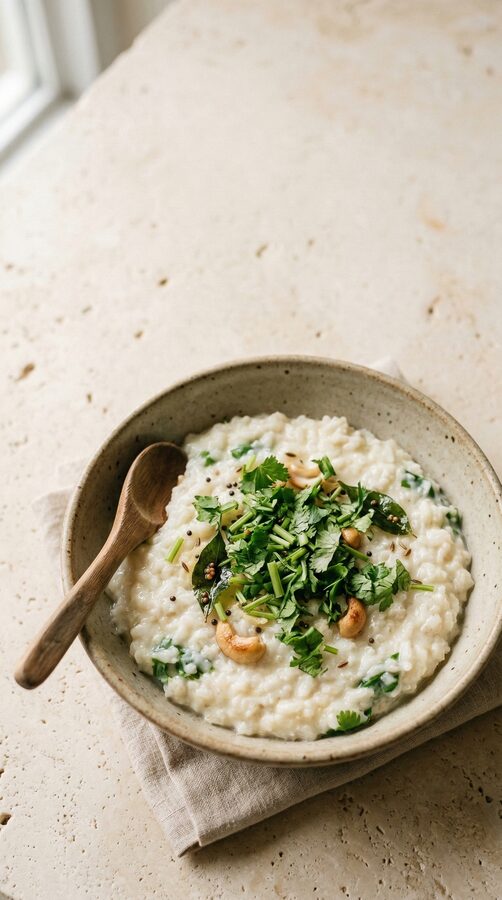
There is a very short list of foods my daughter has never once refused. At the very top of that list, above everything else, is curd rice. Not biryani, not pasta, not even ice cream. Curd rice. I could serve it plain in a steel katori with nothing on top and she would finish it before I sat down.
I started making Kid-Friendly Curd Rice Bowl when I wanted to sneak a few more nutrients into that curd rice she already loved. Same creamy, cool base she was used to, but arranged in a bowl with little piles of toppings: pomegranate seeds for sweetness, peanuts for crunch, cucumber for freshness. She treats it like a game, mixing one topping at a time. Some days she eats only the pomegranate first. I have stopped trying to control the order.
This recipe is as simple as it sounds. Fifteen minutes if your rice is already cooked, practically zero cooking involved. It is Jain-friendly as written, naturally vegetarian, and you can swap the rice for foxtail millet if you are working millets into your family’s meals. If you have a picky eater at home, this one is worth trying.
🍚 Why Curd Rice Is the Ultimate Comfort Food
Curd rice goes by many names across India. In Tamil Nadu it is Thayir Sadam, in Karnataka Mosaranna, in Andhra Pradesh Perugu Annam, and in most North Indian homes it is simply dahi chawal. Every version is essentially the same idea: cooked rice mixed with fresh yogurt, tempered with mustard seeds and curry leaves, and eaten cool or at room temperature.
What makes curd rice special is not complexity. It is the opposite. It is the meal you reach for when you are tired, when your stomach is upset, when the day has been too long and you want something that asks nothing of you. In South Indian tradition, a full thali always ends with curd rice. It is the last course, the one that soothes and settles everything that came before.
For kids, curd rice is one of the earliest solid foods many Indian families introduce. The texture is soft and creamy, the flavour is mild, and it is naturally cooling. My mom gave it to me as a toddler. I gave it to my daughter the same way. Some food traditions do not need updating; they just need a pretty bowl and some toppings.
The “bowl” format is really just a way to make curd rice more fun and more nutritious. Instead of mixing everything in, you arrange small portions of colourful toppings around the edges and let the person eating decide how to combine them. Kids love having that control. So do adults, honestly.
Why Curd Rice Is Good for Your Family
- ✔ Probiotic-rich — fresh curd is packed with live cultures that support gut health and digestion
- ✔ Cooling and soothing — perfect for hot weather, upset stomachs, or after spicy meals
- ✔ Calcium and protein — curd provides both, important for growing kids and vegetarian families
- ✔ Easy to digest — the fermentation in yogurt breaks down lactose, making it gentler than plain milk
- ✔ Endlessly customizable — add whatever toppings your family enjoys; there are no rules
💡 Curd Tip: Always use fresh, thick curd at room temperature. Cold curd straight from the fridge makes the rice stiff and hard to mix. If your curd is sour, add a splash of milk and a tiny pinch of sugar to balance it. For kids especially, slightly sweet curd rice is more appealing than tangy.


Kid-Friendly Curd Rice Bowl
Ingredients
Method
- If your rice is freshly cooked, spread it on a wide plate and let it cool for 10 to 15 minutes. You want it warm, not hot. Hot rice will curdle the curd and make the texture grainy.
- In a large mixing bowl, add the cooled rice. Gently mash it a few times with the back of a spoon. You are not making a paste; just break some grains so the curd clings to them. About 10 to 15 presses is enough.
- Add the curd, milk, and salt. Mix gently with a fork or your hands until everything is creamy and well combined. The consistency should be soft and spoonable, not dry or clumpy. If it feels too thick, add another splash of milk.
- Taste and adjust the salt. The toppings will add their own flavours, so the base should be mildly seasoned.
- Heat coconut oil in a small tadka pan over medium heat.
- Add mustard seeds and wait for them to pop, about 20 seconds.
- Add cumin seeds and let them sizzle for 10 seconds.
- Drop in the curry leaves and dried red chilli (if using). Let the curry leaves crackle for 5 seconds. Add the asafoetida and stir once.
- Turn off the heat immediately. Pour the entire tempering over the curd rice and fold it in gently.
- Spoon the curd rice into bowls, pressing lightly to create a smooth surface.
- Arrange the toppings in small clusters around the bowl: pomegranate seeds on one side, cucumber on another, peanuts in a corner, boondi scattered on top, and raisins if using.
- Finish with a few fresh coriander leaves.
- Serve immediately or pack into a lunchbox. Curd rice tastes great at room temperature.
Notes
FAQs
Q1. Can I make this vegan?
Yes. Use a thick, unsweetened coconut yogurt or cashew yogurt instead of dairy curd. Add a splash of plant milk to loosen. The tempering is already vegan if you use coconut oil instead of ghee. The texture will be slightly different, but it works well. Choose a yogurt that is not too sour.
Q2. Is this safe for toddlers?
Curd rice is one of the most common early foods for Indian toddlers. For very young children (under 2), skip the whole peanuts (choking hazard), skip the dried red chilli in the tempering, and mash the rice a bit more thoroughly. You can offer soft toppings like pomegranate seeds and tiny cucumber pieces depending on their chewing stage.
Q3. Can I make this ahead of time?
You can make the curd rice base a few hours ahead and refrigerate it. It will thicken, so stir in a splash of milk before serving. Always add toppings fresh, just before eating. Pomegranate and cucumber lose their crunch if they sit in the curd too long.
Q4. What other toppings can I add?
Almost anything mild and crunchy works. Some ideas: halved grapes, diced mango (in season), finely chopped bell pepper, roasted cashews, thin sev, grated fresh coconut, or a small drizzle of pickle (for adults). For non-Jain versions, grated carrot is a classic and adds beautiful colour.
Q5. Can I use Greek yogurt instead of Indian curd?
You can, but it will be much thicker and tangier. Thin it with extra milk to get the right consistency. Indian-style curd (or any natural set yogurt) gives the best flavour. If Greek yogurt is your only option, use about 3/4 cup and add milk gradually until it feels creamy and spoonable.
Q6. Why does my curd rice taste sour?
The curd itself is probably over-fermented. Always use fresh curd that has been set for no more than 8 to 10 hours. If your curd has already turned sour, balance it with a pinch of sugar and a splash of fresh milk. Sour curd rice is the number one reason kids reject it, so this step matters.
This Kid-Friendly Curd Rice Bowl is the recipe I make when I do not want a recipe. It takes no effort, creates no mess, and my daughter actually asks for it. That last part alone makes it worth sharing.
It is comfort food in the truest sense: soft, cool, nourishing, and endlessly forgiving. Use rice or use millet. Add five toppings or just one. Eat it for lunch, pack it in a lunchbox, or serve it as the last course of a big meal alongside our Gujarati Dal. It works every time.
If you are cooking for a Jain family, you do not need to change a thing. If you are trying to get your kids to eat something wholesome without a negotiation, start here. And if you are an adult reading this thinking “that sounds like something I would eat right now” — same. I eat this more often than my daughter does, I just do not arrange the toppings as nicely.
Tell me: what is your family’s favourite curd rice topping? Are you team pomegranate, team boondi, or a “mix everything” person? Drop a comment or tag me @petitepaprika 🍚
One thought on “Kid-Friendly Curd Rice Bowl | Easy Jain-Friendly Recipe”