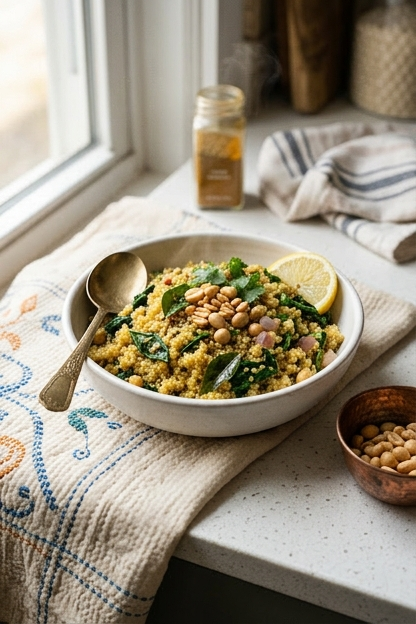
For most of my childhood, breakfast meant a bowl of dal with leftover roti, or on rushed mornings, dry cornflakes eaten standing at the counter. It was only when I moved into my own kitchen and started cooking intentionally that I discovered what breakfast could feel like: warm, nourishing, deeply satisfying from the first bite.
This foxtail millet breakfast bowl came together one weekday morning when I had cooked millet sitting in the fridge and exactly twenty minutes before my day started. A quick cumin-mustard tadka, a handful of spinach wilted in that fragrant oil, a squeeze of lemon off the heat, and roasted peanuts scattered on top. That was it. I’ve made a version of it every week since.
It sits somewhere between an upma and a modern grain bowl. Rooted entirely in Indian technique, but built for how I eat in the morning.
The Story Behind Savory Millet Breakfasts in India
Millets have been a part of Indian cooking for thousands of years, long before they became a wellness trend. In South Indian households, thinai (foxtail millet, called kangni in North India and navane in Karnataka) has appeared in morning porridge, temple offerings, and fasting foods across generations.
The tadka that starts this bowl is pure South Indian kitchen instinct: mustard seeds into hot oil, then cumin, then dried chilli, then aromatics. It is the same technique used in dal, upma, sambhar, and poha. What changes is the grain you pour it over.
This recipe honors that long tradition. The cumin-mustard tadka meets a whole-grain millet base, exactly the kind of bridge between Gujarati and South Indian cooking that I find myself drawn to again and again.
Which Millet Should You Use?
Most recipes say “use any millet,” which works in theory. But the texture differences matter in a savory bowl.
Foxtail millet (thinai / kangni) cooks to a firm, slightly chewy grain that holds its shape in a bowl. It does not clump or turn mushy. This is my first choice for this recipe, and the one I tested it with most.
Barnyard millet (sanwa / sama) is lighter and cooks faster, about 12 minutes. The grains are smaller and fluffier. Good if you want something gentler in the morning.
Little millet (kutki / samai) offers a mild flavor and softens more than foxtail. It works, but tends to absorb the tadka and become uniform in texture rather than staying defined.
For a bowl where you want distinct grains, good chew, and a base that can hold up to wilted spinach and peanuts without turning to porridge: foxtail millet is the right call.
Substitution note: You can use barnyard millet if that is what you have. Reduce the cooking water to 1.75 cups and check at 12 minutes.
Why This Bowl Is a Nutritional Powerhouse
Foxtail millet provides a dense base, and paired with spinach and peanuts, this bowl covers serious nutritional ground for a breakfast.
- Low glycemic index, digests slowly, does not spike blood sugar the way white rice or refined flour would
- High in magnesium and iron, both of which are commonly low in vegetarian diets
- Gluten-free naturally, no modification needed
- Plant protein from roasted peanuts, roughly 7g per 2-tablespoon serving, plus healthy fats that keep you full
- Iron from spinach, especially meaningful paired with the lemon (the vitamin C in lemon increases iron absorption)
- Good for: blood sugar management, PCOS support, vegetarian protein, sustained morning energy
The lemon-and-peanut combination at the end is not just about flavor. It is doing nutritional work.
How to Make the Perfect Cumin-Mustard Tadka
The tadka is the part of this recipe I want you to slow down for. Not because it is difficult, but because once you understand it, you can use it on any grain, any dal, any sabzi.
The sequence matters. Always mustard seeds before cumin seeds. Mustard seeds take longer to splutter and need a slightly cooler oil. If you add them both at once, the cumin burns before the mustard has popped.
How to read the oil temperature: Drop one mustard seed in. If it sizzles and moves to the surface within two seconds, the oil is ready. If it sits and slowly bubbles, wait thirty more seconds.
What you are listening for: The mustard seeds will pop rapidly, like tiny rain on a hot pan. That sound means the volatile oils have released. When the popping slows to an occasional pop, add the cumin seeds.
Cumin goes in next. It will sizzle and darken within 20 to 30 seconds. You want it fragrant and slightly darker, not black. Black means bitter.
Then your aromatics: dried red chilli first (it blooms in the oil), then curry leaves if using (stand back, they spit), then green chilli and ginger.
The lemon goes in last, off heat. This is a small South Indian technique detail that most recipes skip. Lemon squeezed into hot oil or a hot pan turns bitter and loses its brightness. Pull the pan off the flame, wait thirty seconds, then squeeze your lemon over everything. The citrus stays vibrant.

Recipe: Savory Indian Millet Breakfast Bowl

Savory Indian Millet Breakfast Bowl with Cumin-Mustard Tadka
Ingredients
Equipment
Method
- Rinse the foxtail millet under cold water until the water runs clear.
- Combine millet, water, and salt in a small saucepan. Bring to a boil.
- Reduce heat to low, cover, and cook for 15 to 18 minutes until the water is absorbed and grains are cooked through but still hold their shape.
- Remove from heat and let it sit, covered, for 5 minutes. Fluff with a fork.
- Heat oil in a wide pan over medium heat. When the oil shimmers, drop in one mustard seed. If it sizzles immediately, the oil is ready.
- Add mustard seeds. Let them pop for 20 to 30 seconds until the popping slows.
- Add cumin seeds. Stir and let them sizzle for 20 seconds until fragrant and slightly darker.
- Add the dried red chilli and curry leaves (stand back when adding curry leaves, they will spit).
- Add green chilli and ginger. Stir for 30 seconds.
- Add turmeric and stir once to combine.
- Add spinach to the pan. Stir over medium heat for 1 to 2 minutes until just wilted.
- Add the cooked millet to the pan. Toss everything together so the millet is coated in the tadka. Taste and adjust salt.
- Remove from heat. Wait 30 seconds, then squeeze lemon over the bowl.
- Divide into two bowls. Top with roasted peanuts and fresh coriander.
Notes
No fresh curry leaves? Skip them or use 1/4 tsp dried curry leaf powder. The bowl is still excellent.
Oil-free version: Use 2 tbsp water or vegetable broth for the tadka base. The seeds will not splutter the same way, but the flavors develop. Add a pinch more spice to compensate.
Storage: Store cooked millet and tadka separately for best texture. Combined bowl keeps for 1 day.
For kids: Leave out the green chilli and reduce dried red chilli to a small piece. The peanuts can be swapped for sunflower seeds if there is a nut allergy.

Make-Ahead Tips: Prep This Bowl for the Whole Week
This bowl suits batch cooking perfectly, making it a regular in my weekly rotation.
Cook the millet in bulk. One cup of dry foxtail millet gives you about 2 to 2.5 cups cooked. That is four servings. Cook it all at once at the start of the week and refrigerate in an airtight container. It keeps well for 3 days without losing texture.
Make the tadka fresh, not in advance. The tadka takes under 5 minutes, and a fresh tadka over cold, reheated millet tastes much better than a pre-mixed bowl that has been sitting. The mustard-cumin fragrance fades quickly once combined with the grain.
Reheat the millet with a splash of water. Add 1 to 2 tablespoons of water to the cold millet in a pan over medium-low heat, cover, and warm for 2 minutes. Then proceed with the tadka as normal.
Store spinach separately. Wilted spinach does not reheat well. Keep raw spinach in a bag in the fridge and wilt a fresh handful each morning in the tadka.
With pre-cooked millet in the fridge, each morning comes down to: heat millet, make tadka, wilt spinach, squeeze lemon, scatter peanuts. That is genuinely a 7-minute breakfast.
Variations & Substitutions
Can I use bajra (pearl millet) or jowar instead?
Yes, with adjustments. Bajra (pearl millet) has an earthier, slightly bitter flavor that is stronger than foxtail. It works well here but changes the character of the bowl. Use 1.25 cups water per 1/2 cup bajra and cook for 20 to 25 minutes.
Jowar (sorghum) is more neutral and works well too. Use a 1:2 ratio and cook for about 25 minutes. The grains stay more separate, similar to foxtail.
How to add more protein
The peanuts already contribute meaningful plant protein. To push higher: add 1/4 cup sprouted moong (mung beans) tossed into the tadka with the spinach, or top with a spoonful of plain yogurt on the side. Silken tofu cubed into the bowl at the end also works well and does not alter the flavor profile.
Monsoon and winter version
In colder months, I add 1/4 tsp of grated fresh ginger directly to the tadka (in addition to the ginger already in the base), plus a small pinch of dry ginger powder. It makes the bowl taste warmer and is good when you are fighting off a cold. A quarter teaspoon of black pepper ground in at the end amplifies the warming quality further.
Frequently Asked Questions
Q1. Which millet is best for a savory breakfast bowl? Foxtail millet (thinai / kangni) is the best choice for this recipe because it stays firm and holds its grain shape after cooking. It does not turn mushy when mixed with a warm tadka or wilted greens. Barnyard millet works as a lighter substitute; little millet will give a softer texture.
Q2. Is foxtail millet good for diabetics? Yes. Foxtail millet has a lower glycemic index than white rice or most refined grains, meaning it causes a slower, steadier rise in blood sugar. It is also high in dietary fiber, which further slows absorption. That said, always consult your doctor or dietitian for individual guidance.
Q3. Can I make this breakfast bowl ahead of time? You can cook the millet in advance and refrigerate for up to 3 days. The tadka is best made fresh each morning (it takes 4 to 5 minutes). Combining everything in advance is possible but the flavors meld and the textures soften overnight.
Q4. How long does cooked millet keep in the fridge? Cooked foxtail millet keeps well in an airtight container in the refrigerator for up to 3 days. For best texture, store it plain (without the tadka mixed in) and reheat with a splash of water before serving.
Q5. Can I make the tadka without oil? Yes. Use 2 tablespoons of water or vegetable broth in a hot pan. The seeds will cook rather than fry, and you will not get the same burst of fragrance, but the flavor is still good. Add an extra pinch of cumin powder and a few drops of lemon to compensate.
Q6. Is this recipe vegan and gluten-free? It is both naturally. There are no dairy ingredients, and foxtail millet is inherently gluten-free. Just confirm your peanuts are processed in a gluten-free facility if you are cooking for someone with celiac disease.
Q7. Why does the lemon go in off the heat? Lemon squeezed into a hot pan or hot oil turns bitter and the bright citrus note disappears into the dish. Adding it off the heat, once the pan has cooled slightly, keeps the lemon fresh and vibrant. It is a small detail that makes a noticeable difference.
Q8. What is the difference between millet upma and this bowl? Millet upma substitutes semolina with a millet (usually foxtail or barnyard) and follows the same technique: toast or temper, then cook the grain directly in the spiced oil with water. This bowl is slightly different: the millet is cooked separately first, then tossed through a fresh tadka with greens and toppings, more like a grain bowl with Indian seasoning. The texture is drier and more composed, and the toppings (peanuts, spinach, lemon) are treated as bowl components rather than cooked into the grain.
Try This Next
If you enjoy cooking with millets, these recipes from the Petite Paprika Millet Series are worth bookmarking:
- Easy Rice Kheer with Millet Swaps, a sweet, cardamom-scented dessert that uses the same grain
- Foxtail Millet Khichdi, a gentle, one-pot comfort meal for fasting days or when you want something very simple
- Foxtail Millet Vegetable Pulao, a savory, spiced pilaf that works for lunch or a light dinner
This foxtail millet breakfast bowl has become a weekday staple I never overthink. The millet is already in the fridge, the peanuts are in the pantry, the tadka comes together while the millet heats. It is the kind of breakfast that earns its place not because it is impressive, but because it is consistently good.
If you make it, I would love to know: do you prefer your morning grain bowls warmer and saucier, or drier and more textured like this one?
Made this? Share a photo and tag @petitepaprika on Instagram. I love seeing your kitchen creations!
