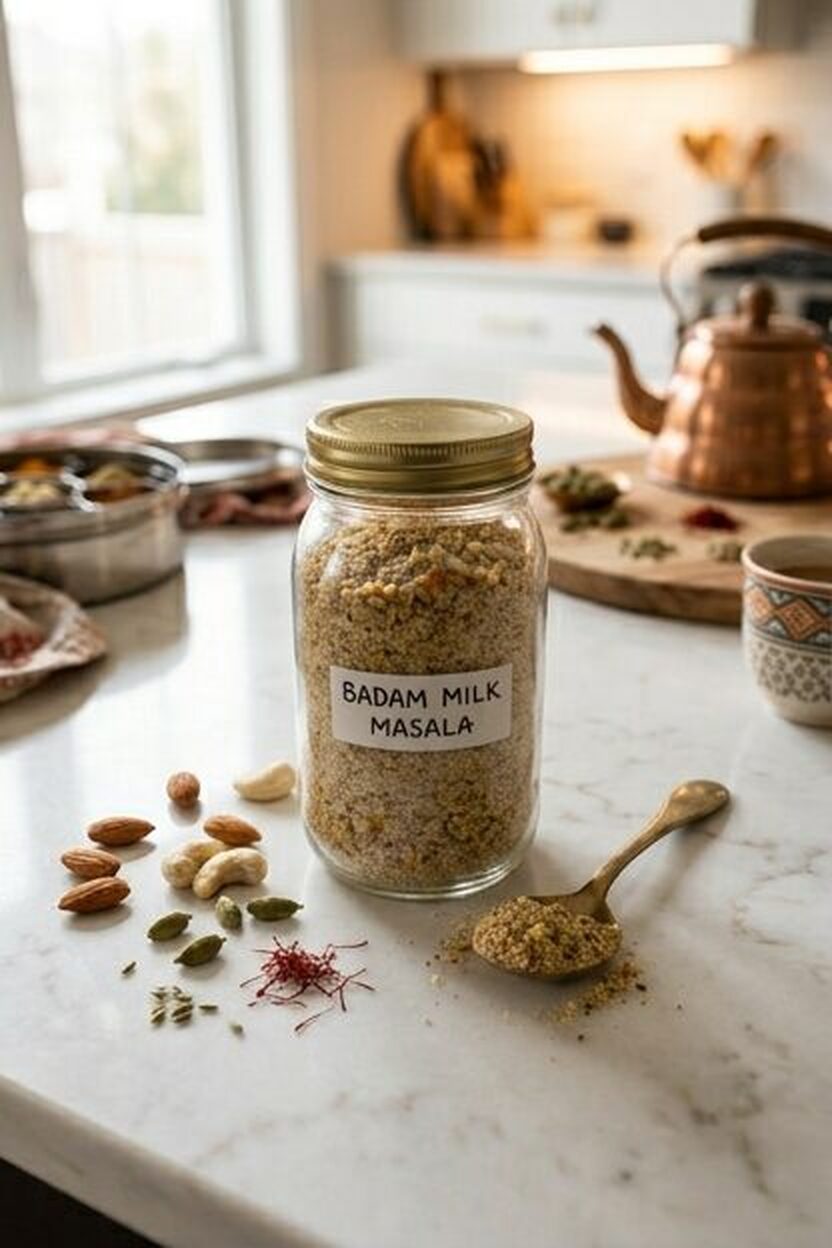
My masi used to send us a little glass jar of this every winter. No label, no instructions: she simply handed it over and said, “Add two spoons to warm milk every night.” We did, and honestly, bedtime milk was never boring again.
This dry fruit powder for milk is one of those recipes every Indian kitchen quietly passes down. It is warm, fragrant, and takes about 15 minutes to make a big batch that lasts you through the season. Since becoming a mom myself, I make a jar every few weeks: one version for our milk at night, and a simpler, baby-safe version for my daughter. Let me show you exactly how we do it.
What Is Dry Fruit Powder for Milk?
It is exactly what it sounds like: a fine powder made from dry-roasted nuts and warming spices, stirred into warm milk just before drinking. Across India it goes by many names. In Gujarat, we call it badam milk masala or sauf badam powder (the fennel seeds are our signature addition)—if you love Gujarati flavours, our methi thepla is another staple we make often. Down south, you will hear nuts powder for milk or simply health powder. In Rajasthani homes, it is stirred into milk spiked with saffron and mishri for a special occasion drink.
Whatever the name, the idea is the same: a concentrated dose of nourishment in every spoon.
Why Make It at Home?
Store-bought versions (Bagrry’s, Patanjali, even the fancy ones) are convenient, but the homemade version wins on every count that matters.
- ✓ No added fillers, starches, or artificial flavours
- ✓ You control the sweetness (or skip it entirely for babies)
- ✓ Fresher aroma: freshly roasted almonds smell completely different from a jar that has sat in a warehouse
- ✓ Customisable: add ragi for extra iron, more cardamom for a warming bite, or a pinch of saffron for a festive batch
- ✓ Costs a fraction of branded versions when you buy nuts in bulk
Ingredients
The Nut Base
- Almonds (badam): The backbone. I use 1 cup as the base. Blanch and peel if you prefer a smoother powder, or use skin-on for extra fibre.
- Cashews (kaju): Adds creaminess and a mild sweetness. Use about half the amount of almonds.
- Pistachios (pista): The green flecks are beautiful and they add a subtle flavour lift.
- Chironji (charoli): Optional, but if you have it, add a small handful. It gives a gentle, almost nutty-sweet depth.
The Spice Mix
- Cardamom (elaichi): 4-5 pods, seeds only. This is non-negotiable.
- Saffron (kesar): A small pinch, dried in the warm pan for 30 seconds. Deepens the colour and adds a floral warmth.
- Fennel seeds (sauf): Here is our Gujarati touch. A teaspoon of fennel seeds makes the powder taste lighter and more digestive-friendly. I always include it.
- Nutmeg (jaiphal): A tiny scrape on a fine grater goes a long way. Omit for babies under 12 months.
Sweetener (Optional)
- Mishri (rock sugar): My preference. It dissolves cleanly in milk and does not taste as sharp as regular sugar.
- Powdered sugar: Fine as a substitute.
- Omit entirely: If you are making this for babies, diabetic family members, or for a Navratri/satvik batch, leave the sweetener out and sweeten the milk separately.
Petite Paprika’s Add-in: Millet Boost
This is the one thing no other dry fruit powder recipe does, and I am genuinely proud of it. For the version I make for my daughter, I stir in 2 tablespoons of ragi (finger millet) powder or foxtail millet powder along with the spices at the end (do not roast the millet powder separately; just mix it in raw).
Ragi brings 344 mg of calcium per 100g. That is more than most nuts. Combined with the almonds, you end up with a powder that is meaningfully iron- and calcium-rich, not just “healthy” in a vague way.

How to Make Dry Fruit Powder for Milk
Yield: ~1.5 cups | Time: 15 minutes | Equipment: Heavy pan, blender or spice grinder
Step 1: Dry Roast the Nuts

Heat a heavy pan on low flame. Add almonds first; they take the longest. Roast, stirring often, for 4-5 minutes until they smell nutty and the skin looks slightly tightened. Add cashews and roast for 2 minutes. Add pistachios and chironji (if using) for 1 more minute. Everything should be lightly golden, fragrant, and warm to the touch. Do not let them darken.
The first time I made this, I walked away to check on something and came back to slightly over-roasted almonds. Still usable, but the flavour had a bitter edge. Keep the flame low and stay close.
Step 2: Dry Roast the Saffron

In the same warm pan (off the flame), add the saffron and let it sit for 30 seconds. The residual heat is enough to dry it so it grinds cleanly.
Step 3: Cool Completely
Spread the roasted nuts on a plate and let them cool for at least 15 minutes. This step is not optional. Blending warm nuts turns the oils loose and you will end up with nut butter, not powder.

Step 4: Blend to a Fine Powder

Add the cooled nuts and saffron to your blender or spice grinder. Blend in short 10-second pulses so the powder stays cool and does not heat up and clump. Stop when you have a fine, even powder with no large pieces. If your blender is getting warm, stop and let it rest for a minute.
Step 5: Add the Spices and Mix
Transfer the nut powder to a bowl. Add cardamom, fennel seeds, nutmeg (if using), and sweetener (if using). If you are making the millet-boosted version, add the ragi or foxtail millet powder now. Mix well with a clean dry spoon.
Taste a pinch. Adjust cardamom or sweetness to your preference.
Step 6: Store
Funnel into a clean, dry glass jar with a tight lid. Done.


Dry Fruit Powder for Milk (Badam Milk Masala)
Ingredients
Method
- Heat a heavy pan on low flame. Add almonds and roast, stirring often, for 4-5 minutes until nutty and skin looks slightly tightened.
- Add cashews and roast for 2 minutes. Add pistachios and chironji (if using) for 1 more minute. Everything should be lightly golden and fragrant. Do not let them darken.
- Spread the roasted nuts on a plate and let cool for at least 15 minutes. Blending warm nuts will turn them into nut butter, not powder.
- In the same warm pan (off the flame), add the saffron and let it sit for 30 seconds. Residual heat is enough to dry it so it grinds cleanly.
- Add the cooled nuts and saffron to a blender or spice grinder. Blend in short 10-second pulses so the powder stays cool and does not heat up and clump. Stop when you have a fine, even powder with no large pieces. If the blender gets warm, stop and let it rest for a minute.
- Transfer the nut powder to a bowl. Add cardamom, fennel seeds, nutmeg (if using), and sweetener (if using). If making the millet-boosted version, add the ragi or foxtail millet powder now. Mix well with a clean dry spoon. Taste a pinch and adjust cardamom or sweetness to your preference.
- Funnel into a clean, dry glass jar with a tight lid.
Baby-Safe Version
If you are making this for a baby who has been introduced to solids, here is what to adjust:
| Age | What to include | What to leave out |
|---|---|---|
| 8 months+ | Almonds, cashews only (small amounts) | All spices, sweetener, saffron, pistachios |
| 12 months+ | All nuts + cardamom | Nutmeg, large amounts of saffron, sweetener |
| 18 months+ | Full recipe, skip or reduce sweetener | Nothing (age-appropriate) |
On nut allergies: If you are introducing tree nuts for the first time, introduce one nut at a time before making a mixed powder. Watch for 48 hours between each introduction. For more ideas that work for little ones, try our kid-friendly curd rice bowl.
The version I make for my daughter (12m+): Almonds, cashews, pistachios, and a whisper of cardamom. No sweetener: her milk is sweet enough on its own. I stir in the ragi powder for the calcium boost and she does not notice it at all.
How to Use This Dry Fruit Powder
The simplest use: stir 1-2 teaspoons into a glass of warm milk. Stir well before drinking as it does settle at the bottom.
It is also great in:
- Porridge and oatmeal: add a teaspoon while cooking
- Smoothies: blend it in directly
- Kheer: stir a teaspoon into this millet kheer for an extra nourishing bowl
- Halwa and laddoo: it adds richness and a subtle spice
For babies, start with half a teaspoon in 100ml of warm milk and work up gradually.
Storage and Shelf Life
- Room temperature (airtight glass jar): 3-4 weeks
- Refrigerator: Up to 2 months
- Always use a clean, dry spoon; even a drop of moisture will cause clumping and shorten shelf life
Gift idea: Pour into small mason jars, tie with a ribbon, and add a handwritten card that says “1-2 tsp in warm milk.” This is one of my favourite Diwali gifts to give—another make-ahead that travels well is our methi thepla. It travels well, everyone loves receiving it, and it has zero plastic.
Variations
Gujarati version: Add 1 tsp fennel seeds (sauf) to the roasting pan in the last 30 seconds. The fennel makes the powder lighter and more digestive. This is the version we grew up with.
South Indian version: Skip fennel, increase cardamom to 6-7 pods, and add 1 tbsp dried coconut (kopra). The coconut deepens the flavour beautifully.
Satvik/Navratri-friendly: Use the base recipe without any sweetener. This is naturally satvik: no onion, no garlic, no restrictions. It fits Navratri, Janmashtami, and Ekadashi fasting perfectly.
Millet-boosted version: Add 2 tbsp ragi or foxtail millet powder with the spices. This is my signature twist and the version I make most often. It turns a simple flavouring powder into something genuinely nourishing.
FAQs
Q1. How much dry fruit powder should I add to milk?
Start with 1 teaspoon per cup of warm milk. I usually use 1.5 teaspoons for myself, but it is very much to taste. Stir well before drinking since it settles.
Q2. Can I give this to my baby?
Yes, with modifications. For babies 8-12 months, use only almonds and cashews with no spices or sweetener. From 12 months, you can add a small amount of cardamom. The full recipe is suitable from 18 months. Always introduce new nuts one at a time first to rule out allergies.
Q3. How long does homemade dry fruit powder last?
Up to 4 weeks at room temperature in an airtight glass jar, and up to 2 months in the refrigerator. Always use a dry spoon to keep moisture out.
Q4. Can I make this without sugar?
Absolutely. Leave out the sweetener entirely and add it to your milk separately when you use it. The unsweetened version is ideal for babies, diabetic family members, and Navratri fasting.
Q5. What is the difference between badam milk powder and dry fruit masala?
Badam milk powder is typically almond-forward with minimal spices and is sweeter, almost like a premix for a drink. Dry fruit masala or dry fruit milk masala includes a wider blend of nuts and spices and is used more like a flavouring; you control how much sweetness you like. This recipe sits in the “masala” category: flexible, spiced, and customisable.
Q6. Can I add ragi to this powder?
Yes, and I strongly encourage it. Add 2 tablespoons of ragi flour to the finished powder and mix well. It does not noticeably change the flavour but adds meaningful calcium and iron, especially useful for growing kids. Do not roast the ragi separately; just mix it in raw at the end.
Closing CTA
Once you have a jar of this on the counter, you will wonder how bedtime milk ever felt like a chore. It takes fifteen minutes to make, lasts for weeks, and the whole family can have a version that works for them.
If you have a family recipe with its own additions (maybe your grandmother stirred in dried coconut, or kept a pinch of pepper in the mix), I would genuinely love to hear it. Leave a comment below and tell me: do you add fennel seeds like we do in Gujarat, or does your version have a twist I should try?
