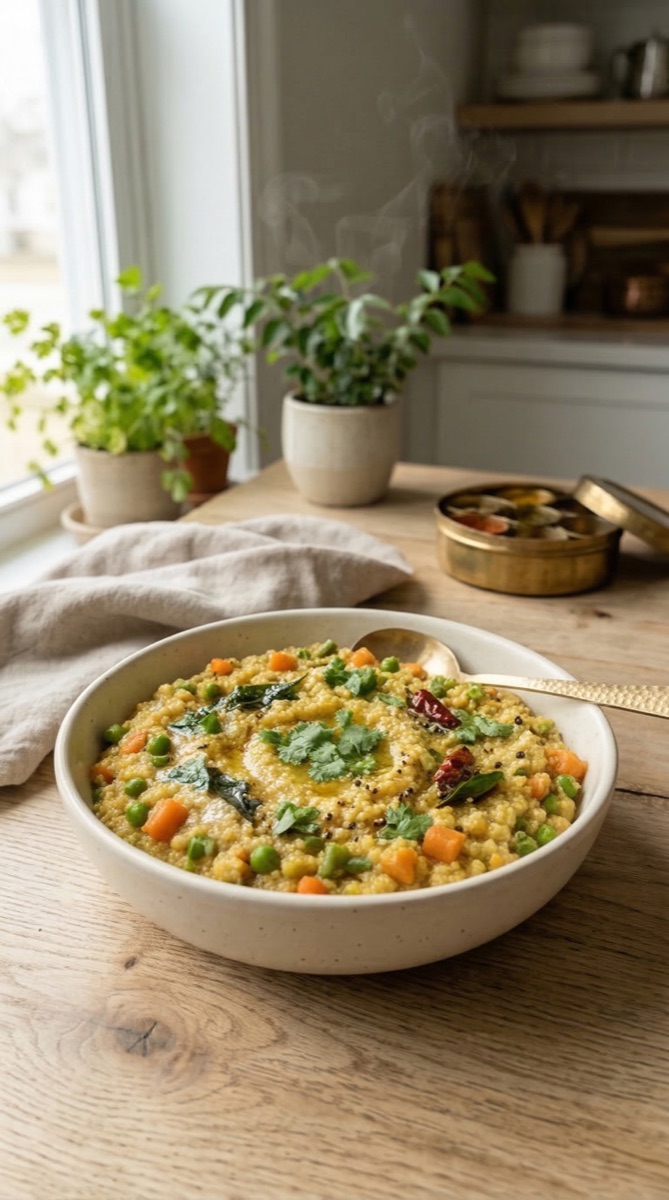
There are evenings when I open the fridge, see a half-used bag of foxtail millet on the shelf, and know exactly what dinner is going to be. A bowl of foxtail millet khichdi: warm, golden, fragrant with a fresh tadka poured right at the end. It is the kind of meal that asks nothing of you and gives everything back.
I grew up eating rice khichdi on sick days and rainy evenings. It was my mom’s answer to “I don’t feel like cooking” and my answer to “I don’t feel like eating anything heavy.” When I started cooking with millets, I swapped the rice for Kang (foxtail millet in Gujarati) and never looked back. The millet version is lighter and nuttier. I found out later it is also far better for blood sugar than the rice original.
What makes this version different from most recipes you will find is the Gujarati vaghareli technique: the tadka is not cooked into the khichdi but poured over it at the very end. That last-minute sizzle of mustard seeds, cumin, and red chilli hitting the cooked millet is what takes this from weeknight meal to something you actually look forward to.
What Is Foxtail Millet? (Kang / Kangni / Thinai)
Foxtail millet is one of the oldest cultivated grains in the world. It has been part of Indian cooking for over 4,000 years. You will find it under different names depending on where you are: Kangni in Hindi, Thinai in Tamil, Kang in Gujarati, and Navane in Kannada.
The grain is small, pale yellow, and cooks up soft and slightly sticky. It is a lot like rice, but with a gentle nuttiness. That texture makes it perfect for khichdi, where you want the millet and dal to meld together into a cohesive, spoonable dish.
If you have already tried my lemon foxtail millet rice, you know how well this grain absorbs spices and aromatics. Khichdi takes that quality even further. When I want something sweet with the same millet, I make easy rice kheer with millet swaps.
Why Foxtail Millet Works Better Than Rice Here
Rice khichdi is comforting but can feel heavy, especially at dinner. Foxtail millet has a lower glycemic index (GI: 34-50 vs. white rice’s GI of ~72), which means it releases energy slowly and keeps you full longer without the blood sugar spike. It also has more protein and fiber per serving, which matters a lot in a vegetarian diet.
Why You Will Love This Foxtail Millet Khichdi
- Ready in 30 minutes: pressure cooker or Instant Pot, no fuss
- Diabetic-friendly: low GI grain, high fiber, steady energy release
- Naturally gluten-free: safe for celiac and gluten-sensitive diets
- One-pot meal: millet, dal, and vegetables all cooked together
- Kid-friendly: soft texture, mild spice level, easy to adjust
- Meal-prep ready: refrigerates for 3 days, reheats beautifully with a splash of water
- Gujarati vaghareli finish: the tadka-at-the-end technique adds a layer of flavour you cannot get any other way
Health Benefits of Foxtail Millet Khichdi
- Low glycemic index (GI 34-50): Suitable for diabetes management and PCOS. Compared to white rice (GI ~72), it causes a much gentler rise in blood sugar.
- High protein: 12.3g per 100g of raw foxtail millet, significantly more than white rice (2.7g per 100g).
- High fiber: 4.4g per serving of cooked khichdi, supporting digestion and gut health.
- Iron and magnesium: Important for vegetarians who may not get enough from plant sources alone.
- Gluten-free: Naturally safe for those with celiac disease or gluten intolerance.
- Anti-inflammatory base: Turmeric and ginger in the recipe add anti-inflammatory compounds alongside the grain’s own benefits.
One serving of this foxtail millet khichdi (approximately 200g) provides around 234 kcal, 8.7g protein, and 4.4g fiber. That is a genuinely nourishing meal, not just a light one.
Foxtail millet khichdi with mixed vegetables and a Gujarati-style tadka finish.

Everything you need for one pot of millet khichdi on the counter.

Foxtail Millet Khichdi (Gujarati Vaghareli Style)
Ingredients
Equipment
Method
- Rinse the foxtail millet and moong dal together under cold water until the water runs clear. Drain and set aside. (Optional: soak together for 20-30 minutes for a slightly less sticky texture and faster cooking.)
- Heat 1 tsp ghee in the pressure cooker over medium heat. Add cumin seeds and let them sizzle for 30 seconds until fragrant.
- Add grated ginger and slit green chillies. Stir for 30 seconds.
- Add the chopped vegetables and stir to coat in the spices. Cook for 1 minute.
- Add the rinsed millet and moong dal. Stir everything together.
- Add 3.5 cups water, turmeric powder, and salt. Mix well.
- Close the lid and cook on medium heat for 3 whistles (if soaked) or 4 whistles (if unsoaked). Let pressure release naturally for about 10 minutes.
- Open and stir gently. If too thick, add a splash of hot water and stir.
- Set Instant Pot to Sauté mode. Add 1 tsp ghee, cumin seeds, ginger, and green chillies. Sauté for 1 minute.
- Add vegetables, rinsed millet, and moong dal. Stir to combine.
- Add 3.5 cups water, turmeric, and salt. Cancel Sauté mode.
- Close lid, set valve to Sealing, and pressure cook on High for 8 minutes. Allow natural pressure release for 10 minutes, then quick-release any remaining pressure.
- Heat 1 tbsp ghee in a small tadka pan over medium-high heat.
- Add mustard seeds. When they begin to pop (about 30 seconds), add cumin seeds, dried red chillies, and asafoetida.
- Add curry leaves — they will crackle. Let the tadka sizzle for 10-15 seconds until golden and fragrant.
- Pour the entire tadka directly over the cooked khichdi and stir it in. Garnish with fresh coriander and serve immediately.
Notes
How to Make Foxtail Millet Khichdi (Step-by-Step)
Pressure Cooker Method
- Heat 1 tsp ghee or oil in the pressure cooker. Add cumin seeds and sizzle 30 seconds.
- Add ginger and green chillies; stir 30 seconds.
- Add mixed vegetables; cook 1 minute.
- Add rinsed millet and moong dal; stir.
- Add water, turmeric, and salt. Pressure cook 3 whistles if soaked, 4 if dry. Natural release ~10 minutes.
- Stir; add hot water if too thick.
Instant Pot Method
- Sauté ghee, cumin, ginger, chillies 1 minute.
- Add vegetables, millet, dal, water, turmeric, salt.
- Pressure cook High 8 minutes; NPR 10 minutes; quick-release remaining.
- Stir; adjust consistency with hot water.
The Gujarati Vaghareli Tadka Finish
Heat ghee in a small tadka pan. Add mustard seeds, then cumin, chillies, hing, and curry leaves. Pour over cooked khichdi and stir. Garnish with coriander.
Tips for the Perfect Foxtail Millet Khichdi
Soak millet and dal 20-30 minutes for less sticky grains and one fewer whistle, or cook dry with extra 1/2 cup water. Reheat with a splash of water; millet thickens overnight.
What to Serve with Foxtail Millet Khichdi
Pair with cucumber raita, Gujarati kadhi, pickle, papad, or an extra drizzle of ghee.
FAQs
Is foxtail millet khichdi good for diabetes?
Yes. Foxtail millet has a lower glycemic index than white rice. Combined with fiber from dal and vegetables, it is a strong choice for steady blood sugar. Watch portion size.
Do I need to soak foxtail millet?
No. Soaking speeds cooking slightly; dry cooking works with extra water and one more whistle.
Can I make this in an Instant Pot?
Yes. Use Sauté then 8 minutes high pressure with 10 minute natural release.
How do I store leftovers?
Refrigerate up to 3 days in an airtight container. Reheat with 2-3 tbsp water per serving.
Can I use other millets?
Little, kodo, and barnyard millet swap 1:1. Bajra and ragi need different recipes.
Is this vegan?
Use coconut oil instead of ghee in the pot and tadka.
Closing
This foxtail millet khichdi is a weekly staple in our kitchen: quick, nourishing, and family-friendly. If you try it, tell me: soaked or no-soak, and did you finish with the vaghareli tadka?
Made this? Share a photo and tag @petitepaprika on Instagram. I love seeing your kitchen creations!
