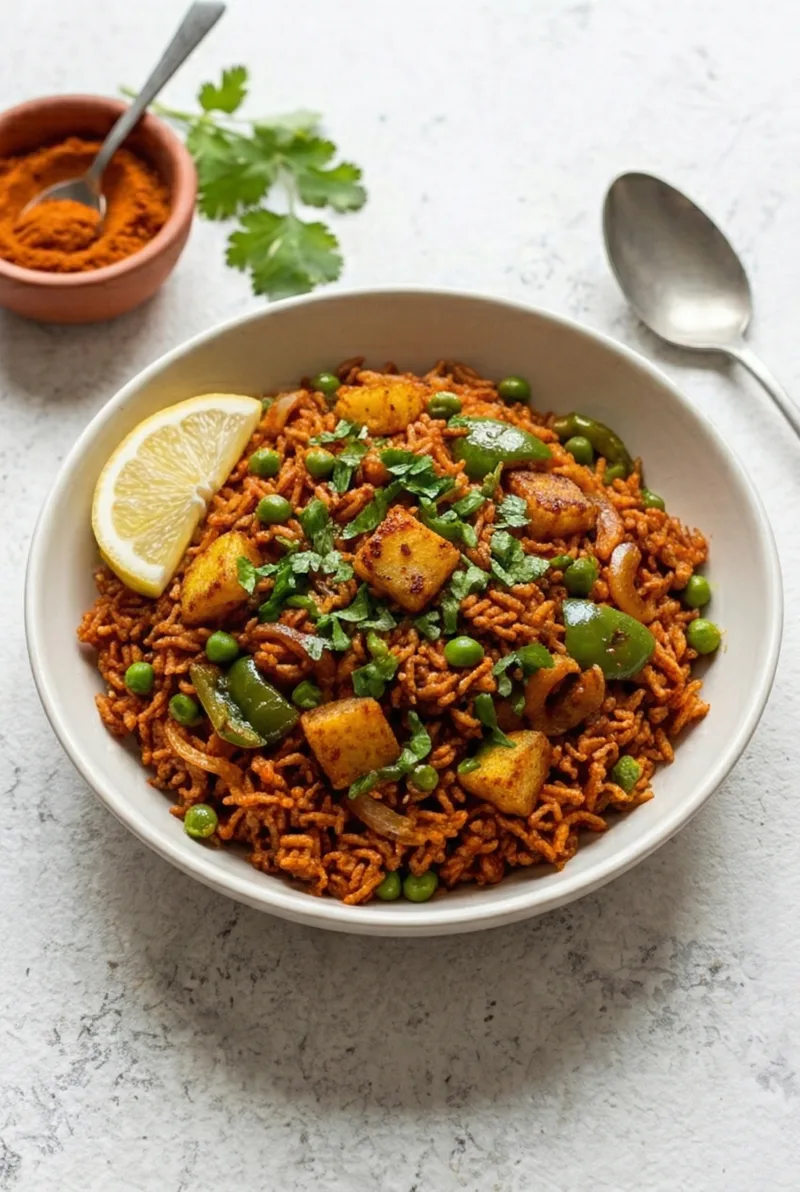
The first time I watched tawa pulao being made, I was wedged into a tiny lane near Dadar station in Mumbai. The vendor had this enormous iron tawa, the size of a small table, and he worked it like a maestro: butter sizzling, pav bhaji masala hitting the hot surface with that unmistakable hiss, a mountain of rice folding in with practiced ease. The smell alone had a queue forming.
Mumbai Tawa Pulao is spicy, buttery street food made by tossing pre-cooked basmati rice with vegetables and pav bhaji masala on a flat iron griddle. And here’s the thing most recipes don’t tell you: it is the perfect recipe for leftover rice. Day-old rice fries up beautifully, giving you separated grains with no mushiness. If you’ve ever looked at a container of cold rice in the fridge and drawn a blank, this recipe is your answer.
We make this at least once a month, usually on a Sunday when there’s rice from the night before and my daughter is asking for “something spicy.” Ready in 30 minutes. Fully vegan if you swap butter for oil. Easy to dial down the heat for little ones.
What is Tawa Pulao?
Tawa pulao is a popular Mumbai street food. “Tawa” refers to the large flat iron griddle used by street vendors, and “pulao” is any spiced rice dish. What makes it different from regular pulao is the method: you start with pre-cooked rice (not raw), cook the vegetables and masala on high heat, then fold the rice in at the end.
The dish became synonymous with Mumbai’s street food culture, especially around areas like Dadar, Crawford Market, and Mohammed Ali Road. Street vendors often use a bhaji leftover from pav bhaji as the base, which is why the flavor profile of tawa pulao and pav bhaji are so deeply connected.
At home, we don’t have a giant tawa, but a wide heavy-bottomed pan or a cast iron skillet works just as well. The key is high heat and confidence while tossing.
Why You’ll Love This Tawa Pulao Recipe
- Uses leftover rice: day-old rice gives perfectly separated grains, not mush
- Ready in 30 minutes, less if your rice is already cooked
- Fully vegan: swap butter for oil
- Naturally gluten-free
- Kid-friendly: heat adjusts easily
- One pan, minimal cleanup
Tips for the Best Tawa Pulao
Use day-old or cooled rice. This is the single most important tip. Freshly cooked rice is too moist and clumps when it hits the hot masala. Rice that has cooled completely, or sat overnight in the fridge, has firmer grains that hold their shape. I always cook a little extra rice the night before on purpose.
Don’t skip the Kashmiri chili-garlic paste. This is what separates a home-style version from a street-style one. Kashmiri chilies give that deep brick-red color you see at Mumbai stalls. They’re mild, so heat still comes from the chili powder. Soak them for 30 minutes, deseed, then blend with garlic and a splash of water. Store extra in the fridge for up to a week.
Use butter, not just oil. Street vendors use a generous amount of butter and it shows in the flavor. If you’re making it vegan, oil works, but a mix of butter and oil gets you closer to the real thing.
High heat, quick toss. Once the rice goes in, toss on high heat and get it off while the grains are still a little crisp. Thirty seconds of extra heat is the difference between fluffy and sticky.
Pav bhaji masala matters. Not all brands taste the same. I like Everest or MDH. If you can’t find it, mix equal parts chole masala with a pinch of amchur (dry mango powder) as a substitute.


Mumbai Tawa Pulao Recipe (Street-Style, 30 Min)
Ingredients
Equipment
Method
- Soak Kashmiri red chilies in hot water for 30 minutes until softened.
- Drain, cut each chili open, and remove the seeds.
- Blend deseeded chilies with garlic cloves and 2-3 tbsp water into a smooth, thick paste. Set aside.
- Boil or steam the potato, carrot, and peas until just fork-tender. Do not overcook.
- Dice the capsicum. Set all vegetables aside.
- Heat butter in a wide heavy-bottomed pan over medium-high heat. Add cumin seeds and let them sizzle for 20-30 seconds.
- Add onion and cook for 3-4 minutes until translucent with lightly golden edges.
- Add ginger-garlic paste and cook for 1 minute until the raw smell disappears.
- If using chili-garlic paste, add 1 tbsp now and cook for 1 minute until it darkens slightly.
- Add chopped tomatoes with salt. Cook on medium-high for 5-6 minutes, stirring often, until tomatoes are completely mushy and the mixture forms a thick paste.
- Add pav bhaji masala, red chili powder, and turmeric. Stir well, add 2 tbsp water, and cook for 1-2 more minutes.
- Add capsicum and cook for 2 minutes until slightly softened but still with some bite.
- Add boiled potato, peas, and carrot. Toss together and cook for 1 minute.
- Turn heat to high. Add cooled rice. Gently fold the rice into the masala using a wide spatula until every grain is coated. Do not stir aggressively; use a cut-and-fold motion.
- Taste and adjust salt. Cook for 1-2 minutes on high heat, tossing occasionally.
- Turn off the heat. Add kasuri methi, fresh coriander, and a squeeze of lemon juice. Toss gently.
- Add a pat of butter if desired. Serve immediately.
Notes
How to Make Mumbai Tawa Pulao (Step-by-Step Photos)

The masala base is ready when it turns a deep brick-red and the butter starts to separate at the edges. This is your flavor foundation.

Use a cut-and-fold motion, not a stir. This keeps the basmati grains intact and coats every grain evenly in the masala.

Finish off the heat: coriander, a squeeze of lemon, crushed kasuri methi, and if you’re feeling indulgent, one last pat of butter.

Making Tawa Pulao in the Instant Pot
If you want to cook the rice from scratch in the Instant Pot and then make tawa pulao, here’s the flow that works for us:
- Rinse 1 cup basmati rice and soak for 20 minutes. Drain.
- In the Instant Pot, combine the rice with 1.25 cups water and a pinch of salt. Pressure cook on High for 5 minutes, then quick release.
- Spread the cooked rice on a wide plate or baking sheet. Let it cool completely, at least 30 minutes, or faster in the fridge. This step is non-negotiable for good texture.
- Once cooled, use the rice exactly as described in the recipe above.
You can also cook the rice a day ahead and store it in the fridge, which is actually ideal. Use this method for perfectly cooked Instant Pot rice every time.
Serving Suggestions for Tawa Pulao
Tawa pulao is a complete meal on its own, but here’s what we love alongside it:
- A cool cucumber raita to balance the spice
- A bowl of Gujarati kadhi: the sweet, tangy yogurt curry cuts through the spice perfectly
- Papad or roasted papadum for crunch
- A bowl of Instant Pot rajma for a full spread
- Masala chaas or plain lassi to cool things down
- A wedge of lemon and raw onion rings, just like the street vendors serve
For a weeknight dinner, I often make just the tawa pulao and pair it with a simple store-bought pickle and yogurt. Done.
Storing and Reheating Tawa Pulao
Fridge: Store in an airtight container for up to 2 days. The flavors deepen overnight and it tastes even better the next day, honestly.
Reheating: Sprinkle 1-2 tsp of water over the rice before reheating in a pan over medium heat, or microwave covered with a damp paper towel for 1-2 minutes. This prevents drying out.
Freezer: Not ideal: the vegetables get soft and the texture suffers. Best eaten fresh or within 2 days.
FAQs
Q1. Can I use freshly cooked rice?
You can, but let it cool completely on a wide plate for at least 30-45 minutes before using. Warm rice has too much steam and moisture, which makes the final pulao sticky and clumped. For the best results, use rice that’s been in the fridge overnight. That extra dryness is what gives you separated, restaurant-style grains.
Q2. Is tawa pulao vegan?
Yes, very easily. Just swap the butter for oil (coconut oil works nicely here) and skip the optional butter garnish at the end. Everything else in this recipe is already plant-based. It’s also naturally gluten-free.
Q3. How do I make it less spicy for kids?
Skip the Kashmiri chili-garlic paste and reduce the red chili powder to just 1/4 tsp (or skip it entirely). The pav bhaji masala itself has a mild heat, so the dish will still have flavor without being too spicy. My daughter loves it this way with an extra pat of butter on top.
Q4. What can I substitute for pav bhaji masala?
In a pinch: 1 tsp chole masala + 1/4 tsp amchur (dry mango powder) + 1/2 tsp garam masala. It won’t be identical, but close enough. If you’re regularly cooking Indian food at home, pav bhaji masala is worth keeping in your pantry; it is also great for adding to sabzis and gravies for a quick flavor boost.
Q5. Can I add paneer?
Absolutely. Add 100g of cubed paneer along with the vegetables in step 13. Lightly pan-fry the paneer first in a separate pan with a little oil until golden on two sides, which keeps it from going soft when you mix it with the rice.
Q6. What if I only have leftover bhaji (from pav bhaji)?
This is actually the most traditional way. Add 2-3 tbsp of the leftover mashed bhaji directly in place of the tomato-masala base in step 10. Skip the separate pav bhaji masala, the bhaji already has it. Add capsicum and onion for texture, fold in the rice, and you have pure Mumbai street food in minutes.
More Quick Weeknight Dinners
Tawa pulao is one of those recipes that earns a permanent spot in your weeknight rotation. It’s fast, it uses what you already have, and it tastes like it took far more effort than it did.
The next time you have leftover rice in the fridge, skip the plain stir-fry and make this instead. Trust me on this one. And if you’re in the mood for another quick weeknight dinner, our veg hakka noodles come together just as fast.
Tell me in the comments: do you go with the Kashmiri chili-garlic paste or keep it simple? I’d love to know how your version turned out.
Made this? Share a photo and tag @petitepaprika on Instagram and I love seeing your kitchen creations!
