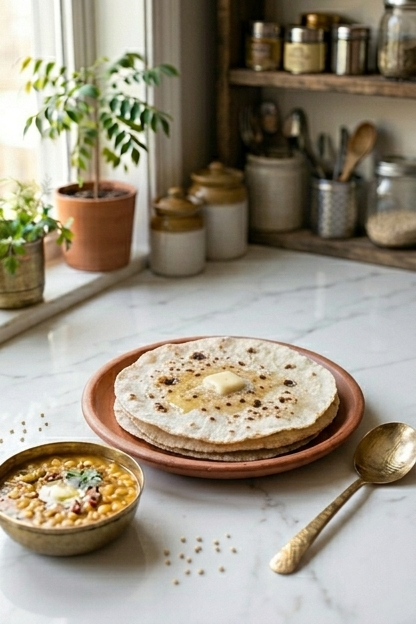
Growing up, I watched my grandmother hand-pat jowar bhakri every single evening. No rolling pin, no measurement. Just flour, hot water, and practiced hands pressing each roti into a thick, rustic circle. The sound of it hitting the hot tawa is one of those kitchen sounds I’ll always associate with home.
Jowar roti is a traditional Indian flatbread made from sorghum flour (jowar atta). You probably know it by different names depending on where your family is from: jolada rotti in Karnataka, jowar bhakri in Maharashtra and Gujarat, jowar ki roti in Hindi-speaking homes. Same humble flatbread, same three ingredients, same deep roots in Indian cooking.
I spent years thinking it was too tricky to make at home. The dough cracks, the roti tears mid-roll. Then I figured out the one thing that changes everything: boiling water. Once I got that right, I was making these weekly. Let me show you how.
What Is Jowar? 🌾
Jowar (sorghum) is a drought-resistant ancient grain that has been a staple crop in Maharashtra, Karnataka, Telangana, and Gujarat for centuries. It’s only recently been rediscovered by the health food world, but Indian home cooks have known its value all along.
Unlike wheat, jowar contains no gluten, which makes rolling the dough a little more challenging (more on that in the tips), but also makes this roti naturally suitable for anyone avoiding gluten.
In Karnataka, jolada rotti is eaten as the main staple, often with spicy eggplant curries or a pat of cold butter. In Gujarat, the jowar bhakri tends to be thicker and is often served with ghee and jaggery as a simple, nourishing meal. Both are worth knowing.
Why You’ll Love This Jowar Roti Recipe
- Gluten-free and vegan with zero substitutions needed
- Just 3 ingredients: jowar flour, water, salt
- Ready in under 20 minutes
- High in iron, fiber, and complex carbohydrates
- Kid-approved when served warm with dal and a drizzle of ghee
Health Benefits of Jowar Roti 💛
Jowar deserves its place in the weekly rotation, and not just for tradition. Here’s why I eat it often, especially when I want something that genuinely nourishes:
- Iron-rich: Jowar provides ~4.4mg of iron per 100g, excellent for vegetarians managing iron intake. I leaned on these heavily during my third trimester when my iron levels needed support.
- Low glycemic index (~62): The complex carbohydrates digest slowly, keeping blood sugar stable. Great for managing diabetes or just avoiding that mid-afternoon crash.
- High fiber (~9.7g per 100g): Supports digestion, promotes satiety, and helps with weight management.
- Calcium and phosphorus: Important for bone health, especially for children and postpartum recovery.
- Naturally gluten-free: No additives, no blends. Just one grain, inherently suitable for celiac or gluten-sensitive individuals.
- Antioxidants (polyphenols): Support heart health and help reduce inflammation.
One jowar roti is approximately 49 calories with 10.2g carbohydrates, 1.5g protein, and minimal fat. That makes it a genuinely light, nourishing bread.
Ingredients
- 1 cup jowar flour (sorghum flour / jowar atta)
- ½ cup water (boiling)
- ¼ tsp salt
- Pinch of ajwain / carom seeds (optional)
- Ghee or oil for brushing (optional)

How to Make Jowar Roti
Step 1: Make the Dough
Bring ½ cup water to a full boil. Add the salt (and ajwain if using) to the jowar flour in a mixing bowl.
Pour the boiling water directly over the flour and mix immediately with a spoon or silicone spatula. The flour will clump into a shaggy mass. That’s exactly right.
Once it’s cool enough to handle (about 2 minutes), knead briefly into a smooth, pliable dough. It should feel soft but not sticky. If it’s too dry and cracking, add 1 teaspoon of hot water at a time.
Why boiling water? Jowar has no gluten, so there’s nothing to stretch and hold the dough together. Boiling water partially cooks (gelatinizes) the starch, which gives the dough the plasticity it needs. Skip this and you’ll get cracks everywhere. I learned this the hard way.
Rest the dough for 5 minutes under a damp cloth before rolling.
Step 2: Shape the Rotis
Divide the dough into 4 equal balls.
Option 1 — Rolling pin: Place a ball between two sheets of parchment paper or plastic wrap. Roll gently from the center outward into a circle about 6–7 inches across. Press lightly, jowar dough is more fragile than wheat dough.
Option 2 — Hand-patting (traditional method): Wet your palms slightly. Place the dough ball on a flat surface and press outward in circular motions with your palm and fingers. This takes a little practice but produces beautiful, slightly rustic rotis with uneven edges that I personally love.
If you get a crack at the edge, just press it back together. It’s fine.
Step 3: Cook on Tawa
Heat a tawa or flat cast-iron pan over medium heat. Once hot, place the roti on it.
Cook for 1–2 minutes until you see the surface start to dry out and small brown spots form underneath. Flip.
Cook the second side for another 1–2 minutes. For a puffed roti, carefully place it directly on a low gas flame for 15–20 seconds per side. The steam inside puffs it up. Not essential, but it’s satisfying every time.
Brush with ghee immediately off the tawa. Serve warm.


Jowar Roti (Sorghum Flatbread)
Ingredients
Equipment
Method
- Bring ½ cup water to a full boil.
- Combine jowar flour and salt in a mixing bowl. Add ajwain if using.
- Pour boiling water over the flour and mix immediately with a spoon until it comes together into a shaggy dough.
- Once cool enough to handle, knead briefly until smooth and pliable. Add 1 tsp more hot water if dough feels dry or cracking.
- Cover with a damp cloth and rest for 5 minutes.
- Divide dough into 4 equal portions and roll into smooth balls.
- Place one ball between two sheets of parchment paper and roll gently into a circle about 6–7 inches across. Or wet your palms and hand-pat the dough into a circle on a flat surface.
- Heat a tawa over medium heat until hot.
- Place the roti on the tawa and cook for 1–2 minutes until the surface looks dry and small brown spots appear on the bottom.
- Flip and cook the second side for 1–2 minutes.
- Optional: using tongs, hold the roti briefly over a direct low flame for 15–20 seconds per side until it puffs slightly.
- Remove from heat, brush with ghee, and serve immediately.
Notes
Tips for Soft Jowar Roti (No Cracks!)
These are the things I wish someone had told me when I first started making these:
- Boiling water, not warm water. This is non-negotiable. Warm water won’t gelatinize the starch enough.
- Rest the dough. Even 5 minutes makes it noticeably more pliable.
- Roll between parchment. It prevents sticking and reduces tearing, especially as you’re learning.
- Medium heat, always. Low heat dries the roti before it cooks; high heat burns the outside before the inside sets.
- Wet palms for hand-patting. Just a little moisture on your hands prevents sticking.
- Add water gradually. Different brands of jowar flour absorb differently, so adjust by the teaspoon.
What to Serve With Jowar Roti
This is such a versatile flatbread. Some of my favorite pairings from our kitchen:
- Palak dal — the classic, nourishing combination
- Jowar sabudana khichdi — for a full jowar meal (weekend navratri thali!)
- Methi thepla sides like cucumber raita or karela nu shaak
- Traditional Gujarati style: thick bhakri with a pat of cold butter and jaggery, simple and deeply satisfying
- Kid-friendly: warm roti with yellow dal and a small drizzle of ghee. My toddler always wants seconds.
Storage & Make-Ahead
Jowar roti is best eaten fresh off the tawa. They firm up as they cool.
If you need to store them: wrap in a clean kitchen towel and keep in an airtight container at room temperature for up to 1 day. Reheat on a dry tawa for 30 seconds per side.
Meal prep tip: The dough can be made ahead and refrigerated for up to 24 hours in a cling-wrapped bowl. Roll and cook fresh when needed.
FAQs
Q1. Is jowar roti gluten-free?
Yes, completely. Jowar (sorghum) is a naturally gluten-free grain, no additives or blends needed. It’s suitable for people with celiac disease or gluten sensitivity as long as you use certified gluten-free jowar flour (to avoid cross-contamination).
Q2. Is jowar roti good for diabetes?
It’s one of the better flatbread choices for managing blood sugar. Jowar has a glycemic index of around 62 and is high in fiber, which means carbohydrates digest slowly and don’t cause sharp spikes. That said, portion size still matters. Always consult your doctor or dietitian for personalized advice.
Q3. Can I eat jowar roti for weight loss?
Yes. Jowar is high in fiber and complex carbs, which keep you fuller for longer. At about 49 calories per roti with minimal fat, it’s a genuinely light bread. Pair it with protein-rich dal for a balanced meal.
Q4. Why does my jowar roti crack?
Two most common reasons: the water wasn’t hot enough, or the dough is too dry. Use fully boiling water and add a little more if the dough feels stiff. Also make sure you rest the dough for at least 5 minutes before rolling.
Q5. Can I make jowar roti ahead of time?
You can make the dough ahead and refrigerate it for up to 24 hours. Roll and cook fresh. Cooked rotis firm up quickly and are best eaten warm.
Q6. What is the difference between jowar bhakri and jowar roti?
They’re the same flatbread, just named differently by region. “Roti” is the more general North Indian term for flatbread; “bhakri” is the Marathi/Gujarati word for this thick, hand-patted sorghum bread. Jolada rotti is the Kannada name. The preparation is identical.
Jowar roti is one of those recipes that rewards a little patience. The first few might crack, the rolling might feel awkward, but within a couple of batches your hands will know exactly what the dough needs.
It’s become a weekly staple in our home. Some nights it’s the “I don’t know what to cook” dinner with leftover dal. Other evenings it’s the centerpiece of a full thali. Either way, it shows up.
If you’re exploring millets in your cooking, jowar is a wonderful place to start. Try my jowar sabudana khichdi next — it uses the same grain in a completely different way. And if you’re building more nourishing meals into your week, my roundup of iron-rich vegetarian recipes is a good place to look.
Are you team hand-patted bhakri or rolling pin? I’d love to know how yours turned out.
Made this? Share a photo and tag @petitepaprika on Instagram — I love seeing your kitchen creations!
